{{ _getLangText('m_detailInformation_goodsActivityText') }}
{{ activityObj.name }}
{{ _getLangText('m_detailInformation_goodsActivityText') }}
{{ item.activityName }}
{{ _getLangText('m_detailInformation_goodsActivityBuyButText') }}
{{ _getLangText("m_detailIntroduction_goodsIntroductionText") }}
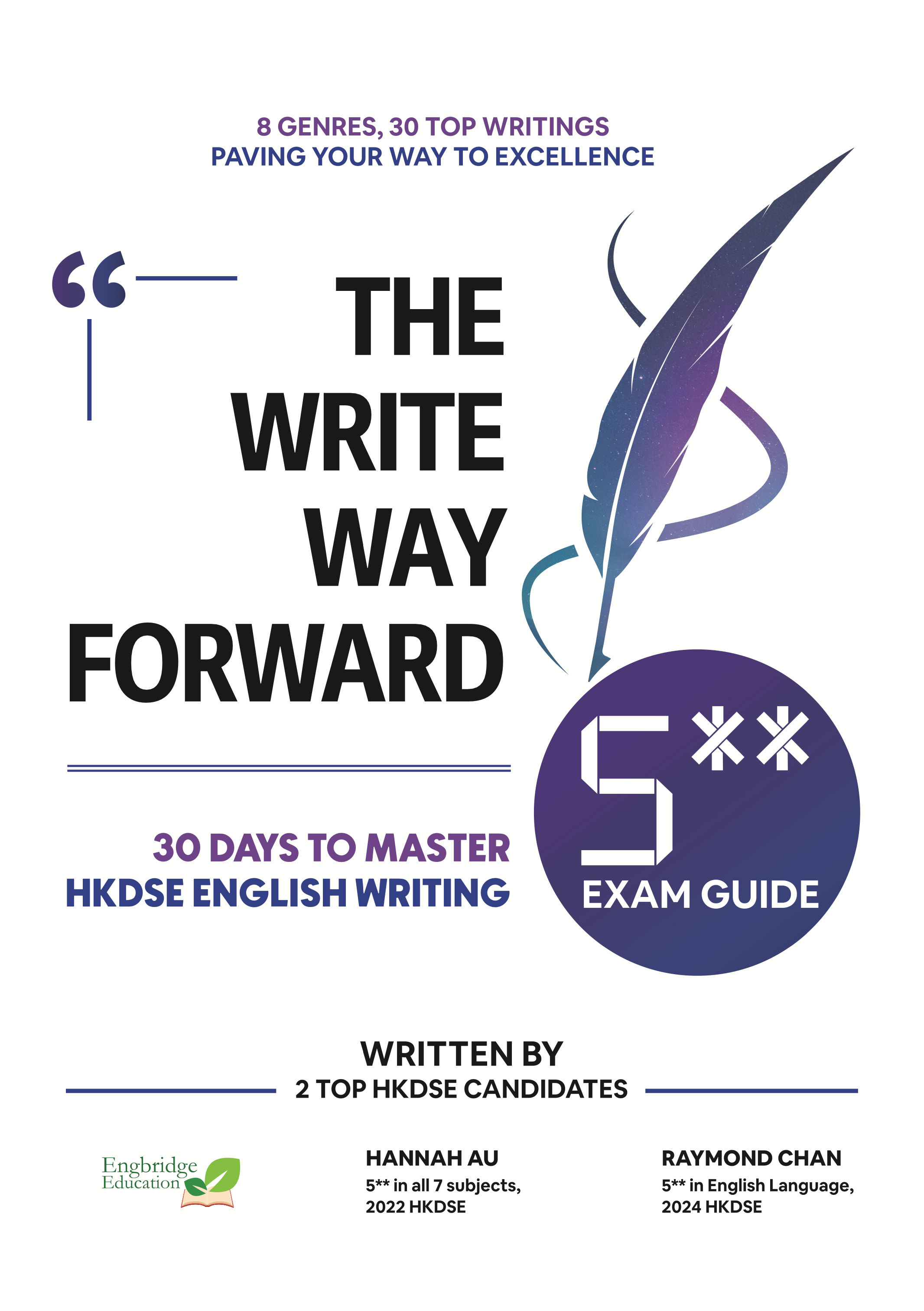
本產品是DSE英文科適用的英作系列The Write Way Forward
書內使用語言: English
釘裝方法: 膠裝
產品尺寸: A5 (148x210)
產品類別: 寫作範文
收錄30 篇 2022 DSE 狀元 Hannah Au 及 2024 DSE 英文 5** 尖子 Raymond Chan 精選文章
包攬多種文體,展現靈活寫作技巧 從零開始,運用作者自創STEEL method 及OPERA framework, 由結構大綱、推演闡述,到選詞用字,全面提升英文寫作技巧,啟發潛能,輕鬆踏上英文寫作之路。
The STEEL Method is a step-by-step guide that illustrates how to systematically approach an HKDSE English writing question. STEEL stands for Structure, Tone, Elements, Elaboration, and Language
Structure: 8 common genres are introduced, with their structural frameworks laid out at the start of each part (A to H) in Section 2 of the book. Students can refer to the framework to ensure they don’t leave out any part of their writing.
Tone: The importance of audience awareness is highlighted, and examples of typical phrases for formal, semi-formal, and informal writings are listed.
Elements: This section provides an in-depth explanation of how to come up with content points while students plan their writing.
Using sample writings from Section 2 as an example, students are shown how they can follow a logical flow of ideas to brainstorm a chain of arguments and select their stance (if applicable) in an argumentative essay. The OPERA Framework, specially built for students who may find it challenging to brainstorm arguments for argumentative texts, is also introduced. It acts as a skeleton for brainstorming main arguments in five different dimensions, namely “overriding benefits or costs”, “practicality”, “effectiveness”, “root causes”, and “accountability”. This guides them to consider multiple perspectives of a phenomenon or a policy.
Regarding descriptive text types, students are taught to use the five senses and their personal reflection as a starting point.
Elaboration: Using sample writings from the book, this section illustrates how students can elaborate on their main content points using three distinct strategies.
Language: Students are taught how to build a vocabulary bank by learning synonyms grouped by topic and by meaning. Selected sentence structures that are useful across numerous text types and topics are also introduced.
書內使用語言: English
釘裝方法: 膠裝
產品尺寸: A5 (148x210)
產品類別: 寫作範文
收錄30 篇 2022 DSE 狀元 Hannah Au 及 2024 DSE 英文 5** 尖子 Raymond Chan 精選文章
包攬多種文體,展現靈活寫作技巧 從零開始,運用作者自創STEEL method 及OPERA framework, 由結構大綱、推演闡述,到選詞用字,全面提升英文寫作技巧,啟發潛能,輕鬆踏上英文寫作之路。
The STEEL Method is a step-by-step guide that illustrates how to systematically approach an HKDSE English writing question. STEEL stands for Structure, Tone, Elements, Elaboration, and Language
Structure: 8 common genres are introduced, with their structural frameworks laid out at the start of each part (A to H) in Section 2 of the book. Students can refer to the framework to ensure they don’t leave out any part of their writing.
Tone: The importance of audience awareness is highlighted, and examples of typical phrases for formal, semi-formal, and informal writings are listed.
Elements: This section provides an in-depth explanation of how to come up with content points while students plan their writing.
Using sample writings from Section 2 as an example, students are shown how they can follow a logical flow of ideas to brainstorm a chain of arguments and select their stance (if applicable) in an argumentative essay. The OPERA Framework, specially built for students who may find it challenging to brainstorm arguments for argumentative texts, is also introduced. It acts as a skeleton for brainstorming main arguments in five different dimensions, namely “overriding benefits or costs”, “practicality”, “effectiveness”, “root causes”, and “accountability”. This guides them to consider multiple perspectives of a phenomenon or a policy.
Regarding descriptive text types, students are taught to use the five senses and their personal reflection as a starting point.
Elaboration: Using sample writings from the book, this section illustrates how students can elaborate on their main content points using three distinct strategies.
Language: Students are taught how to build a vocabulary bank by learning synonyms grouped by topic and by meaning. Selected sentence structures that are useful across numerous text types and topics are also introduced.
{{_getLangText('m_asideShopInfo_info1Text') }}
Joint-Us & Original Press
{{ _getLangText("m_recently_viewed_products_titleText") }}